LM-79 Moving Detector Goniophotometer (Mirror Type C)
LSG-6000

High Precision Rotation Luminaire Goniophotometer
LSG-1890B

High Precision Rotation Luminaire Goniospectroradiometer
LSG-1890BCCD

Goniophotometer for Automotive and Signal Lamps
LSG-1950

Goniophotometer for Traffic Signal Lamps
LSG-1950S

Compact Goniophotometer
LSG-1200A

Near Field Moving Detector Goniophotometer
LSG-1900B


Select an organization
to browse standards
Introduction
The emission of a light source is often represented using the far-field luminous intensity distribution. It is now challenging to calculate the conventional limiting photometric distance to achieve far-field conditions due to the introduction of luminaires with vast arrays of LEDs and focused lenses. Therefore, the goniophotometer plays a vital role in this field.
Determining illuminance on a work surface in the near-field area may lead to incorrect predictions even when using accurate far-field data. Near-field representation may solve these issues, but it lacks experimental confirmation. An array of two to five narrow-beam LEDs was used in laboratory studies near and distant fields.
A near-field method eliminates debates about determining the far-field photometric distance and leads to accurate illuminance at any point inside the array, regardless of array size and component beam angles. Utilizing near-field light source representation in lighting design allows for more accurate predictions when using LED arrays with focusing lenses.
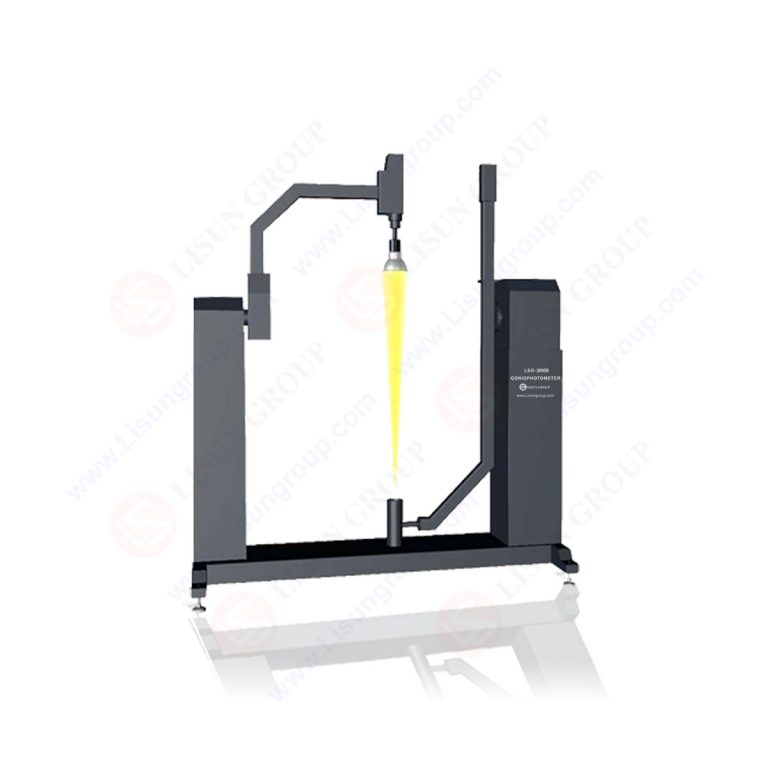
Near field goniophotometer
When using a near field detector, light from the light source is received directly by the detector without going through any mirrors. The usual measuring distance is about 3 meters. A photometer head or a series of photometer heads may be used as the near field detector.
Using a near-field camera, take measurements To determine the light intensity of tiny or weak sources and the distribution of illumination in each area, the goniophotometer is the most accurate method available today.
Main characteristics
1. Determination of the spatial distribution of spectral energy
2. Recognize the colorimetric quantities’ mean and “non-uniformity” and calculate them with precision
3. Luminance meter for images
4. Light sources’ spatial brightness distributions are measured and analyzed.
Far-field goniophotometer
The far-field detector receives the light after two times of reflection by the rotating mirror M1 and the fixed mirror M2, with a typical distance of about 30m between the two mirrors. As a result, the dark room’s volume does not increase by this. Depending on the situation, you may use it to measure the intensity of significant sources with either a narrow or a broad beam angle. You can quickly get these goniophotometers from LISUN.
The fact that test lights or luminaires do not move during measurement sampling means that mistakes caused by movement may be avoided, and the sample can be kept as stable as possible, both of which are desirable outcomes.
The system inhibits the rotation of the test samples around the horizontal axis, and the rotating speed around the test light source may be breakneck while the system is in operation. The whole field speed is measured in seconds. The goniophotometer may be configured in various ways to meet the specific needs of the user community. You can conduct near-field and far-field measurements and light distribution and spatial color measurements by combining several detectors in a single setup.
Main characteristics
1. With a single full-field goniophotometer, a user may possess several high-precision goniophotometers that simultaneously perform various tasks.
2. To minimize costs, the client may optionally choose just one function.
3. The presence of “background noise “or parasitic light is deficient.
4. Because the whole system is operating in a somewhat open environment, unexpected light can travel away from the direction of the measuring light. It is a vast improvement over the scene when a large amount of dispersed light is reflected in a small tunnel.
5. The mirror goniophotometer’s height requirement is much lower than that of other mirror goniophotometers.
Lisun Instruments Limited was found by LISUN GROUP in 2003. LISUN quality system has been strictly certified by ISO9001:2015. As a CIE Membership, LISUN products are designed based on CIE, IEC and other international or national standards. All products passed CE certificate and authenticated by the third-party lab.
Our main products are Goniophotometer, Integrating Sphere, Spectroradiometer, Surge Generator, ESD Simulator, EMI Receiver, EMC Test Equipment, Electrical Safety Tester, Environmental Chamber, Temperature Chamber, Climate Chamber, Thermal Chamber, Salt Spray Test, Dust Test Chamber, Waterproof Test, RoHS Test (EDXRF), Glow Wire Test and Needle Flame Test.
Please feel free to contact us if you need any support.
Tech Dep: Service@Lisungroup.com , Cell/WhatsApp: +8615317907381
Sales Dep: Sales@Lisungroup.com , Cell/WhatsApp: +8618917996096
Your email address will not be published. Required fields are marked *


 English
 中文简体
中文简体 English
 Русский
 Español
 Português
 Türkçe
 العربية
 Deutsch
 Polski
 Italiano
 Français
 한국어
한국어 ไทย
ไทย Tiếng Việt
 日本語
日本語