LM-79 Moving Detector Goniophotometer (Mirror Type C)
LSG-6000

High Precision Rotation Luminaire Goniophotometer
LSG-1890B

High Precision Rotation Luminaire Goniospectroradiometer
LSG-1890BCCD

Goniophotometer for Automotive and Signal Lamps
LSG-1950

Goniophotometer for Traffic Signal Lamps
LSG-1950S

Compact Goniophotometer
LSG-1200A

Near Field Moving Detector Goniophotometer
LSG-1900B


Select an organization
to browse standards

Product No: GNGPL-6216a
This VDE 0620-1 Lehre 16a Lehre zur Prüfung der größten Abzugskraft des Steckers 2P + AC 250 V 16 A is precision-engineered and manufactured in strict compliance with the relevant requirements of the VDE 0620-1:2010 (including VDE 0620-1:2005-04) standard. It is specifically designed to test the maximum withdrawal force of 2P + AC 250 V 16 A plugs, ensuring that the connection reliability and structural stability of plugs and sockets meet industry safety and performance standards, preventing accidental disconnection during use.
Specifications:
• Complies with DIN VDE 0620-1 “Plugs and socket-outlets for household and similar purposes Part 1: General requirements on fixed socket-outlets” Lehre 16a
• Adheres to VDE 0620-1:2010 and VDE 0620-1:2005-04 standards
• Designed for testing 2P + AC 250 V 16 A plugs’ maximum withdrawal force
• Key dimensional specifications (in mm): 19⁺⁰·⁰⁰/₀, 18±0.5, 32±0.5, 3±0.5, 4.86⁻⁰·⁰¹, minimum 16.5 mm, minimum 55 mm, 105 mm
• Material specifications:
• Handle: Insulating material (type selected by the manufacturer)
• Body and pins: Hardened stainless steel (type selected by the manufacturer)
Test Procedures:
• Prepare the 2P + AC 250 V 16 A plug and matching socket to be tested, ensuring they are clean, undamaged, and placed in a stable testing environment.
• Inspect the gauge to confirm it is intact, free from deformities, and meets the specified dimensional and material requirements.
• Insert the plug fully into the socket in accordance with normal usage specifications to ensure a secure connection.
• Attach the gauge to the plug correctly following standard operating guidelines to measure the withdrawal force.
• Apply a gradual and steady pulling force to the gauge until the plug is disconnected from the socket, recording the maximum force value during this process.
• Compare the recorded maximum withdrawal force with the requirements specified in VDE 0620-1:2010 to evaluate if the plug and socket comply with the standard.
Applications:
• Maximum withdrawal force testing and quality inspection of 2P + AC 250 V 16 A plugs in the electronics industry.
• Compliance verification of plug and socket connection reliability during production in the electrical appliance manufacturing sector.
• Routine quality control in plug and socket production enterprises to ensure stable withdrawal force performance.
• Performance inspection of household and similar-purpose 2P + AC 250 V 16 A electrical plugs and sockets.
• Research and development testing for new 2P plug designs to meet maximum withdrawal force standard requirements.
• Third-party certification and inspection services for 2P + AC 250 V 16 A plug and socket products.
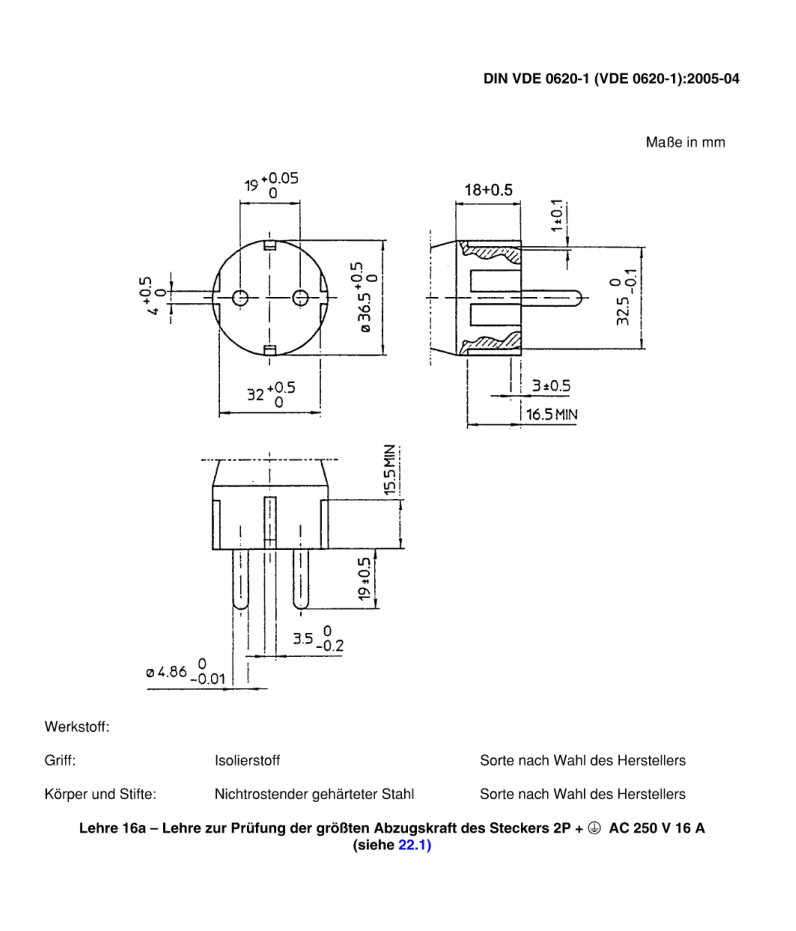
VDE 0620-1 Lehre 16a Lehre zur Prüfung der größten Abzugskraft des Steckers 2P + AC 250 V 16 A


 English
 中文简体
中文简体 English
 Русский
 Español
 Português
 Türkçe
 العربية
 Deutsch
 Polski
 Italiano
 Français
 한국어
한국어 ไทย
ไทย Tiếng Việt
 日本語
日本語