LM-79 Moving Detector Goniophotometer (Mirror Type C)
LSG-6000

High Precision Rotation Luminaire Goniophotometer
LSG-1890B

High Precision Rotation Luminaire Goniospectroradiometer
LSG-1890BCCD

Goniophotometer for Automotive and Signal Lamps
LSG-1950

Goniophotometer for Traffic Signal Lamps
LSG-1950S

Compact Goniophotometer
LSG-1200A

Near Field Moving Detector Goniophotometer
LSG-1900B


Select an organization
to browse standards
A spectrophotometer is a common tool for color measurement, widely used in color evaluation, color control, color matching, and material composition analysis. This precise instrument operates by using a spectrophotometer to graphically display spectral ratios and emission curves, calculating measurement values using fixed formulas. The spectrophotometer automatically records all measured data and calculates the final results.
A spectrophotometer mainly consists of four parts:
• Light Source: Provides the necessary light for measurement.
• Integrating Sphere: Distributes the light uniformly to ensure accurate measurement.
• Grating (Monochromator): Separates the light into different wavelengths.
• Photodetector: Detects and records the intensity of the dispersed light.
Different brands and models of spectrophotometers may vary in measurement principles, primarily categorized into single-beam and double-beam measurement principles.
Single-Beam Measurement Principle
Single-beam spectrophotometers are equipped with one grating and one detector. During measurement, the light source flashes twice to measure the sample and the standard. Although the light source may change slightly between the two measurements, differences in light source intensity distribution, optical path, and temperature can introduce some errors, affecting measurement accuracy.
Double-Beam Measurement Principle
Double-beam spectrophotometers are equipped with two gratings and two detectors. The light source flashes once to measure the sample and the standard simultaneously. This method overcomes the errors caused by system changes, improving measurement accuracy. Despite the higher manufacturing cost, double-beam spectrophotometers provide more reliable measurement results.
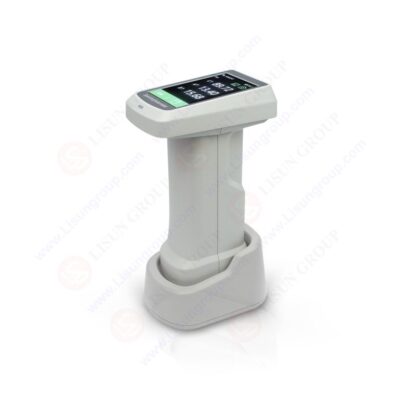
Portable spectrophotometer
Spectrophotometers have two primary observation modes:
• 0/45 Degree:
This mode is mainly used for measuring smooth surfaces and is commonly found in portable spectrophotometers. Its limitation is the inability to connect to a computer for color matching, making it suitable for simple on-site measurements.
• d/8 Degree Integrating Sphere:
This mode can measure surface color differences and connect to a computer for color matching. The d/8 degree integrating sphere method offers more powerful functions, producing more stable and accurate results, ideal for applications requiring high precision and multifunctionality.
• Color Evaluation:
Spectrophotometers can accurately evaluate the color of samples, helping users judge color differences and consistency.
• Color Control:
In industrial production, spectrophotometers monitor and control product colors, ensuring batch-to-batch color consistency.
• Color Matching:
In industries like printing and painting, spectrophotometers assist in color matching and mixing, improving color matching accuracy and efficiency.
• Material Composition Analysis:
By analyzing the spectral characteristics of materials, spectrophotometers can identify and analyze material composition.
• Calibration:
To ensure measurement accuracy, spectrophotometers need calibration before use. There are two calibration methods:
Standard Sample Calibration: Using known color standard samples.
Light Source Calibration: Using the original data of the light source.
Calibration ensures that the spectrophotometer maintains consistent standards under different testing conditions, ensuring accurate results.
• Sampling:
Before testing, a sample needs to be taken from the object. This step usually involves taking a small piece from the object’s surface, avoiding contamination and damage to ensure accurate results.
• Measurement:
Fix the sample on the spectrophotometer as required. Input the necessary measurement items through the instrument’s interface and illuminate the sample with the light source. After a certain testing period, record the test data.
• Result Analysis:
After obtaining the measurement data, analyze and calculate the color difference value to determine the accuracy of the color compared to the standard sample. Based on the analysis, take subsequent actions such as adjusting production processes or correcting color formulas.
A spectrophotometer is a precise color detection device, playing a crucial role in color evaluation, color control, color matching, and material composition analysis. Understanding its different observation modes and measurement principles helps select a suitable spectrophotometer for specific application needs, thereby improving measurement accuracy and efficiency.
Tags:HSCD-860Your email address will not be published. Required fields are marked *


 English
 中文简体
中文简体 English
 Русский
 Español
 Português
 Türkçe
 العربية
 Deutsch
 Polski
 Italiano
 Français
 한국어
한국어 ไทย
ไทย Tiếng Việt
 日本語
日本語