LM-79 Moving Detector Goniophotometer (Mirror Type C)
LSG-6000

High Precision Rotation Luminaire Goniophotometer
LSG-1890B

High Precision Rotation Luminaire Goniospectroradiometer
LSG-1890BCCD

Goniophotometer for Automotive and Signal Lamps
LSG-1950

Goniophotometer for Traffic Signal Lamps
LSG-1950S

Compact Goniophotometer
LSG-1200A

Near Field Moving Detector Goniophotometer
LSG-1900B


Select an organization
to browse standards
Environmental testing refers to exposing products or materials to specific conditions, either natural or artificial, to evaluate their performance under realistic storage, transportation, and usage scenarios. This type of testing is crucial for ensuring product quality and performance.
High-low temperature test chambers typically involve three main types of testing: natural exposure testing, field testing, and artificial simulation testing. Natural exposure and field testing can be costly and time-consuming, with relatively poor repeatability and consistency in results. However, these tests offer valuable insights into real-world usage scenarios, providing important foundations for artificial simulation testing.
Artificial simulation environmental testing is widely used in quality inspection. To ensure comparable and repeatable results, a series of standardized methods for basic environmental testing of products have been established. These standardized methods help ensure the scientific rigor and accuracy of testing processes, providing effective assurance and guidance for product design and manufacturing.
Evaluates product suitability for storage and usage under high and low temperature conditions.
Determines product adaptability and structural integrity under rapid temperature changes.
Evaluates product response to humid conditions, including changes in electrical and mechanical performance and resistance to corrosion.
• Constant Humidity Test:
Primarily for products that mainly absorb moisture without significant permeation or diffusion, assessing if they provide sufficient protection.
• Alternate Humidity Test:
An accelerated environmental test to determine product suitability under cyclic temperature and humidity changes, often conducted with condensation on product surfaces.
• Room Temperature Humidity Test:
Tests products under regular temperature and high relative humidity conditions.
• Corrosion Resistance Test:
Checks product resistance to corrosion from saltwater or industrial atmospheres, widely used in electronics, light industry, and metal materials.
• Artificial Accelerated Corrosion Test:
Utilizes tests like neutral salt spray to accelerate assessment of product corrosion resistance and evaluate coating quality.
These environmental testing methods help evaluate and validate product performance and durability under various conditions, enhancing product quality and reliability to ensure optimal performance in real-world environments.
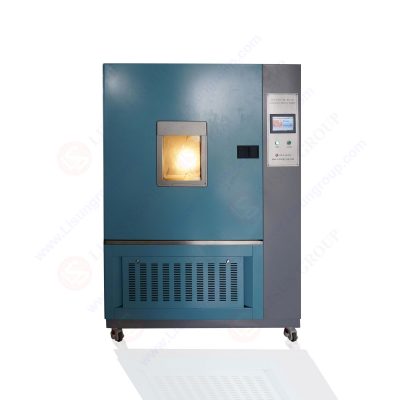
GDJS-015B Temperature Humidity Chamber | Thermal Chamber
• Accurate Cooling and Heating Functions:
Precisely controls and maintains stable temperatures, ensuring uniform heating and cooling to consistently impact tested items.
• Safety Protection Systems:
Incorporates comprehensive safety measures, including automatic alarm systems to alert operators to equipment malfunctions or anomalies, ensuring operator and equipment safety.
• High-Quality Materials and Design:
Features materials resistant to high and low temperatures, corrosion, and oxidation, while being easy to clean. The design emphasizes simplicity, elegance, and fine craftsmanship.
• Scientifically Rational and User-Friendly Design:
Incorporates user-friendly design elements such as convenient operation interfaces, adjustable shelves, intelligent displays, and observation windows to enhance operational convenience and comfort.
• Effective Insulation Performance:
Equipped with compression devices or sealing strips to ensure sustained insulation performance during operation.
• Low-Noise Design:
Internal fans feature noise reduction mechanisms to minimize operational noise, providing a conducive working environment for operators.
With advancing technology, high-low temperature test chambers continue to innovate toward greater intelligence, accuracy, safety, and usability, meeting diverse user needs and expanding application areas.
Tags:GDJS-015BYour email address will not be published. Required fields are marked *



 English
 中文简体
中文简体 English
 Русский
 Español
 Português
 Türkçe
 العربية
 Deutsch
 Polski
 Italiano
 Français
 한국어
한국어 ไทย
ไทย Tiếng Việt
 日本語
日本語