LM-79 Moving Detector Goniophotometer (Mirror Type C)
LSG-6000

High Precision Rotation Luminaire Goniophotometer
LSG-1890B

High Precision Rotation Luminaire Goniospectroradiometer
LSG-1890BCCD

Goniophotometer for Automotive and Signal Lamps
LSG-1950

Goniophotometer for Traffic Signal Lamps
LSG-1950S

Compact Goniophotometer
LSG-1200A

Near Field Moving Detector Goniophotometer
LSG-1900B


Select an organization
to browse standards
Impedance analyzers are crucial testing devices used to assess the impedance characteristics of electronic components, circuits, and materials. With the rapid advancement of electronic technology, impedance analyzers are increasingly vital in fields such as circuit design, material science, and biomedical engineering.
The principle of impedance analyzers is based on Ohm’s Law and phase-sensitive detection technology. Ohm’s Law states that in a direct current (DC) circuit, current is directly proportional to voltage, with resistance being the ratio of voltage to current. However, in alternating current (AC) circuits, impedance becomes a complex number due to the phase difference between voltage and current. Hence, the task of the impedance analyzer is to measure this complex impedance.
Specifically, impedance analyzers generate one or more frequency test signals, which are applied to the test object through test fixtures. The analyzer then simultaneously measures the voltage across the test object and the current passing through it, along with their phase difference. Finally, by calculating the ratio of voltage to current and the phase difference, the impedance parameters of the test object are obtained. In this process, phase-sensitive detection technology plays a crucial role by accurately measuring the phase difference between voltage and current to obtain the imaginary part of impedance.
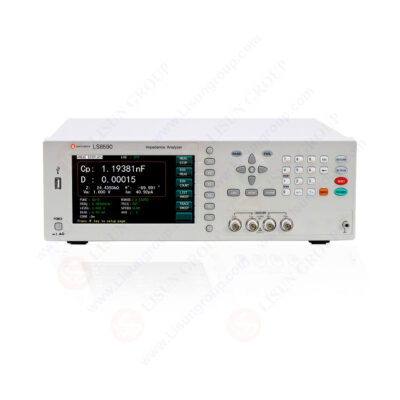
LS90_Impedance analyzer
• High Accuracy Measurement: Employing advanced techniques and algorithms, impedance analyzers provide high-precision impedance measurements, with certain models achieving a basic accuracy of 0.05%.
• Wide Frequency Range: Supporting measurements from microhertz (μHz) to gigahertz (GHz), impedance analyzers cover a broad frequency spectrum suitable for impedance measurements at different frequencies.
• Multiple Measurement Parameters: Capable of measuring various impedance parameters such as impedance magnitude, real and imaginary parts, phase difference, and calculating parameters like conductance, inductance, and capacitance.
• Graphical Display: Featuring graphical display capabilities, impedance analyzers visually present measurement results, facilitating data analysis and interpretation.
• Flexible Configuration Options: Supporting various test fixtures and connection methods allows impedance analyzers to be flexibly configured according to the characteristics and requirements of the test object.
• Rich Control and Trigger Functions: Providing extensive control and trigger functions, including external triggering, gate triggering, and internal triggering, to meet complex testing requirements.
• High Sampling Rate: With high-speed sampling rates, impedance analyzers support impedance measurements of high-speed signals, offering advantages in high-frequency communication and high-speed data transmission.
• Circuit Design: Used to measure impedance characteristics of electronic components in circuit design to optimize circuit performance and stability.
• Material Science: Employed to measure impedance characteristics of dielectric materials such as biological tissues, food, and geological samples, providing insights into their physical and chemical properties.
• Biomedical Engineering: Utilized for assessing the health status of biological tissues, disease diagnosis, and studying cell membrane impedance to understand cellular functions and physiological processes.
Impedance analyzers play a critical role as essential electronic testing instruments in circuit design, material science, and biomedical engineering. Understanding their principles, features, and applications enables effective utilization for various measurement and analysis tasks, thereby contributing to the advancement and application of electronic technology.
Tags:LS90Your email address will not be published. Required fields are marked *


 English
 中文简体
中文简体 English
 Русский
 Español
 Português
 Türkçe
 العربية
 Deutsch
 Polski
 Italiano
 Français
 한국어
한국어 ไทย
ไทย Tiếng Việt
 日本語
日本語