LM-79 Moving Detector Goniophotometer (Mirror Type C)
LSG-6000

High Precision Rotation Luminaire Goniophotometer
LSG-1890B

High Precision Rotation Luminaire Goniospectroradiometer
LSG-1890BCCD

Goniophotometer for Automotive and Signal Lamps
LSG-1950

Goniophotometer for Traffic Signal Lamps
LSG-1950S

Compact Goniophotometer
LSG-1200A

Near Field Moving Detector Goniophotometer
LSG-1900B


Select an organization
to browse standards
A power parameter tester, also known as an electrical parameter measurement device, is primarily used for measuring various electrical parameters of instruments and equipment, including voltage, current, power, and power factor. It encompasses different types such as digital power parameter testers, single-phase power parameter testers, and three-phase power parameter testers. Among these, digital power parameter testers, characterized by compact size and stable quality through surface-mount technology, feature rich interface and measurement capabilities. They can comprehensively measure parameters such as harmonics, PWM waveforms, and no-load losses, meeting the requirements for laboratory testing of power frequency products.
• Single-phase: Widely used for measuring devices like televisions and transformers.
• Three-phase: Suitable for parameter measurement in three-phase instruments such as motors.
• AC, DC, and AC/DC Power Parameter Testers:Depending on specific application needs, these testers are tailored for measuring AC, DC, or both types of electrical parameters.
• Accuracy: Standard power parameter testers typically offer a precision level of 0.5, indicating an error margin of 0.5%. High-precision models, such as the Shanghai LISUN LS2050 series, achieve accuracies up to 0.02%.
• Components: Consist of power sensors (probes) and indicators. The power sensor converts high-frequency electrical signals into detectable electrical signals, while the indicator includes signal amplification, conversion, and display functions.
• Power Range: Specifies the measurable power range, from minimum to maximum, determined by the power probe.
• Maximum Allowable Power: The highest input power (typically average power) that the probe can handle without damage.
• Frequency Range: Ensures measurement accuracy and performance for signals within a specified frequency range.
• Measurement Accuracy: Refers to the calibrated accuracy of the power probe, excluding system mismatch errors.
• Stability: Depends on the stability of the power probe and indicator’s zero drift and noise interference.
• Response Time: Also known as the time constant of the power sensing element, it indicates the time required for the power indicator to reach 64% of its stable value.
• Probe Type and Impedance: Matching probe frequency and power range ensures compatibility with the signal being tested.
The versatility and high accuracy of power parameter testers make them indispensable tools in electrical systems. They are crucial for testing and evaluating various electrical equipment, ensuring compliance with performance standards and operational safety. These devices are pivotal in:
• Quality Assurance: Ensuring devices meet stringent quality and performance standards during production.
• Maintenance and Diagnostics: Facilitating regular maintenance checks and fault diagnostics to prevent downtime.
• Energy Efficiency Optimization: Evaluating power losses to optimize energy usage and improve system efficiency.
• Safety Compliance: Verifying safety parameters such as grounding and insulation resistance to prevent electrical hazards.
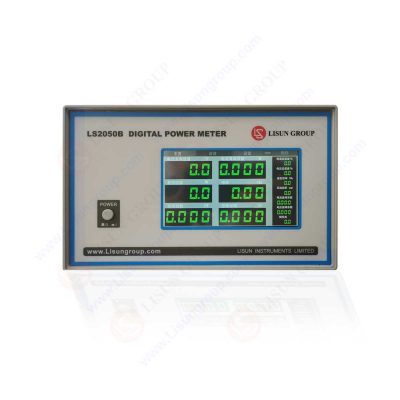
LS2050 High Accuracy AC and DC Power Meter
In conclusion, power parameter testers play a vital role in accurately measuring electrical parameters across a wide range of applications. Their comprehensive functionality and high precision enable effective evaluation and maintenance of electrical equipment, contributing to enhanced reliability, safety, and efficiency in electrical systems.
Tags:LS2050Your email address will not be published. Required fields are marked *


 English
 中文简体
中文简体 English
 Русский
 Español
 Português
 Türkçe
 العربية
 Deutsch
 Polski
 Italiano
 Français
 한국어
한국어 ไทย
ไทย Tiếng Việt
 日本語
日本語