LM-79 Moving Detector Goniophotometer (Mirror Type C)
LSG-6000

High Precision Rotation Luminaire Goniophotometer
LSG-1890B

High Precision Rotation Luminaire Goniospectroradiometer
LSG-1890BCCD

Goniophotometer for Automotive and Signal Lamps
LSG-1950

Goniophotometer for Traffic Signal Lamps
LSG-1950S

Compact Goniophotometer
LSG-1200A

Near Field Moving Detector Goniophotometer
LSG-1900B


Select an organization
to browse standards
The particle filtration efficiency tester is a specialized instrument used to assess the filtration efficiency of products such as air purifiers, masks, and automotive air purifiers. Its role is to ensure that these products effectively filter out harmful particles and gases from the air, thereby protecting people’s health.
The principle of the particle filtration efficiency tester is based on two methods: particle counting and particle weighing. These methods involve introducing particles or gases into the testing system and detecting them using optical or chemical means to determine the effectiveness of the filter.
Particle Counting Method: This method uses a laser particle counter to measure the number of particles. During the test, a certain amount of particles is injected into the space where the test object is located. Then, the laser beam scans the area, and the number of particles scanned within a specific time period is recorded. Finally, the filtration efficiency of the filter is calculated based on the recorded data.
Particle Weighing Method: This method correlates the mass of particles with the concentration and flow rate of pollutants to evaluate the filtration efficiency. The testing instrument first measures the total mass of particles entering the filter, then measures the total mass of particles exiting the filter. Finally, the filtration efficiency is calculated by comparing the input and output masses of particles.
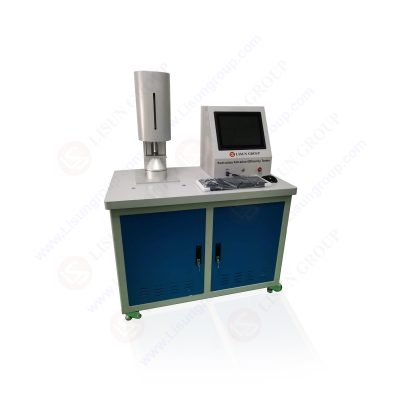
GLE-20 Face Masks Particulate Filtration Efficiency PFE Tester
Filtration Efficiency:
Filtration efficiency refers to the percentage of particles successfully filtered out by the filter under specified testing conditions. It is an important indicator of filter performance, usually expressed as a percentage.
Oil Mist Method Detection:
The oil mist method detection is a commonly used method that utilizes oil-based aerosols such as DEHS (di-ethyl hexyl sebacate), PAO (polyalphaolefin), or DSP (dimethyl silicone oil) to evaluate the filtration performance of filters. In this method, oil-based aerosols are introduced into the testing system, and the change in particle concentration before and after the filter treatment airflow is measured to determine the filter’s filtration efficiency.
Salt Fog Method Detection:
The salt fog method detection is another commonly used method that uses NaCl (sodium chloride) or equivalent halides as aerosols to evaluate the filtration performance of filters. In this method, NaCl aerosols are introduced into the testing system, and the change in particle concentration before and after the filter treatment airflow is measured to determine the filter’s filtration efficiency. The salt fog method detection is commonly used to evaluate the filtration effect of filters on fine particles, especially in high humidity environments.
Oil Mist Method Testing Principle:
• Preparation of Aerosol: Dry, oil-free compressed air is introduced into an aerosol generator at a certain flow rate to produce aerosols with a certain particle distribution.
• Aerosol Screening: Aerosols pass through a cascade impactor for screening, and particles with a particle size distribution that meets standard requirements are discharged from the aerosol outlet.
• Entering the Testing Pipeline: Aerosols that meet the standard enter the testing pipeline, where the test filter is installed.
• Pressure Difference Monitoring: Pressure difference sensors are installed on both sides of the filter to monitor the number of particles and pressure difference upstream and downstream of the filter during the test.
• Testing Process: The entire testing process is conducted at a constant flow rate or air volume to ensure the stability and comparability of the test conditions.
Salt Fog Method Testing Principle:
• Preparation of Salt Fog Aerosol: Dry, oil-free compressed air is introduced into an aerosol generator at a certain flow rate to produce aerosols with a certain particle distribution.
• Aerosol Screening: Similar to the oil mist method, aerosols pass through a cascade impactor for screening, and particles with a particle size distribution that meets standard requirements are discharged.
• Neutralization Treatment: Since the salt fog aerosol carries static electricity, it needs to be neutralized.
• Heating Treatment: The aerosol is heated to produce salt particles. This process involves mixing the aerosol that meets the particle size requirements with heated gas, and then evaporating the water in the aerosol to produce salt particles.
• Entering the Testing Pipeline: Processed salt fog aerosols enter the testing pipeline, where the test filter is installed.
• Pressure Difference Monitoring: Similar to the oil mist method, pressure difference sensors are installed on both sides of the filter to monitor the number of particles and pressure difference upstream and downstream of the filter during the test.
• Testing Process: The entire testing process is conducted at a constant flow rate or air volume to ensure the stability and comparability of the test conditions.
Your email address will not be published. Required fields are marked *


 English
 中文简体
中文简体 English
 Русский
 Español
 Português
 Türkçe
 العربية
 Deutsch
 Polski
 Italiano
 Français
 한국어
한국어 ไทย
ไทย Tiếng Việt
 日本語
日本語